Issue #16 — September 25, 2026
Within Tolerance, Still Wrong
Morning.
Construction has a measurement for almost everything.
And every once in a while, something meets the written standard and still looks completely wrong when you step back.
This week, we're looking at the space between "within tolerance" and "I'd have that in my house."
Market Conditions

The Good News / Bad News
The Good News: Builder confidence moved in the right direction, barely. Fewer builders also reported cutting prices.
Nobody is popping champagne, but at least fewer people are discounting it.
The Bad News: Buyers still had mortgage rates in the mid-6s, softwood lumber remained nearly 12% higher than last year and August set a gas-price record.
In the Trenches
'It's within tolerance.'
Maybe.
There is no universal 1/4-inch tolerance covering everything in a house.
The acceptable variation depends on the material, application, manufacturer and applicable performance standard.
Houses need tolerances.
We're building them from wood, concrete, steel and several unscheduled trips to the hardware store and lumberyard.
Things move. Materials vary. People install them.
Demanding absolute perfection everywhere would make houses impossible to finish.
But meeting a written tolerance doesn't automatically make the finished product acceptable.
Context matters.
A 1/4-inch variation across a long foundation wall might never be noticed.
Now put a countertop against finished drywall that bows 1/4 inch across 32 inches.
You're probably going to see it.
No glasses required.
The countertop gives your eye a long, straight reference line. What looked minor on an empty wall becomes a visible gap behind the backsplash.
Anyone who has found half a tube of caulk in a "small crack," raise your hand.
I'll raise mine first. Don't worry.
You don't want a homeowner or potential buyer seeing that.
Worse, you don't want it becoming a warranty item because everyone somehow missed it during the walkthrough.
This is where the superintendent has to look beyond whether something technically passes.
Where is the variation?
What gets installed beside it?
Will cabinets, tile, trim or countertops make it more noticeable?
Can it be corrected now, or are we about to spend three times as much hiding it later?
Not every imperfect surface needs to be torn apart.
Sometimes an adjustment with trim, drywall mud or caulk is reasonable. Other times, the acceptable variation sits in exactly the wrong place and needs to be corrected before the next trade arrives.
The written standard gives us a way to measure the work.
It doesn't replace judgment.
Because it may meet the written standard.
It still has to pass the eye.
And eventually, the Google review.
Who Did This?
The fiberglass shower did its job here.
It made an out-of-plumb wall impossible to ignore.
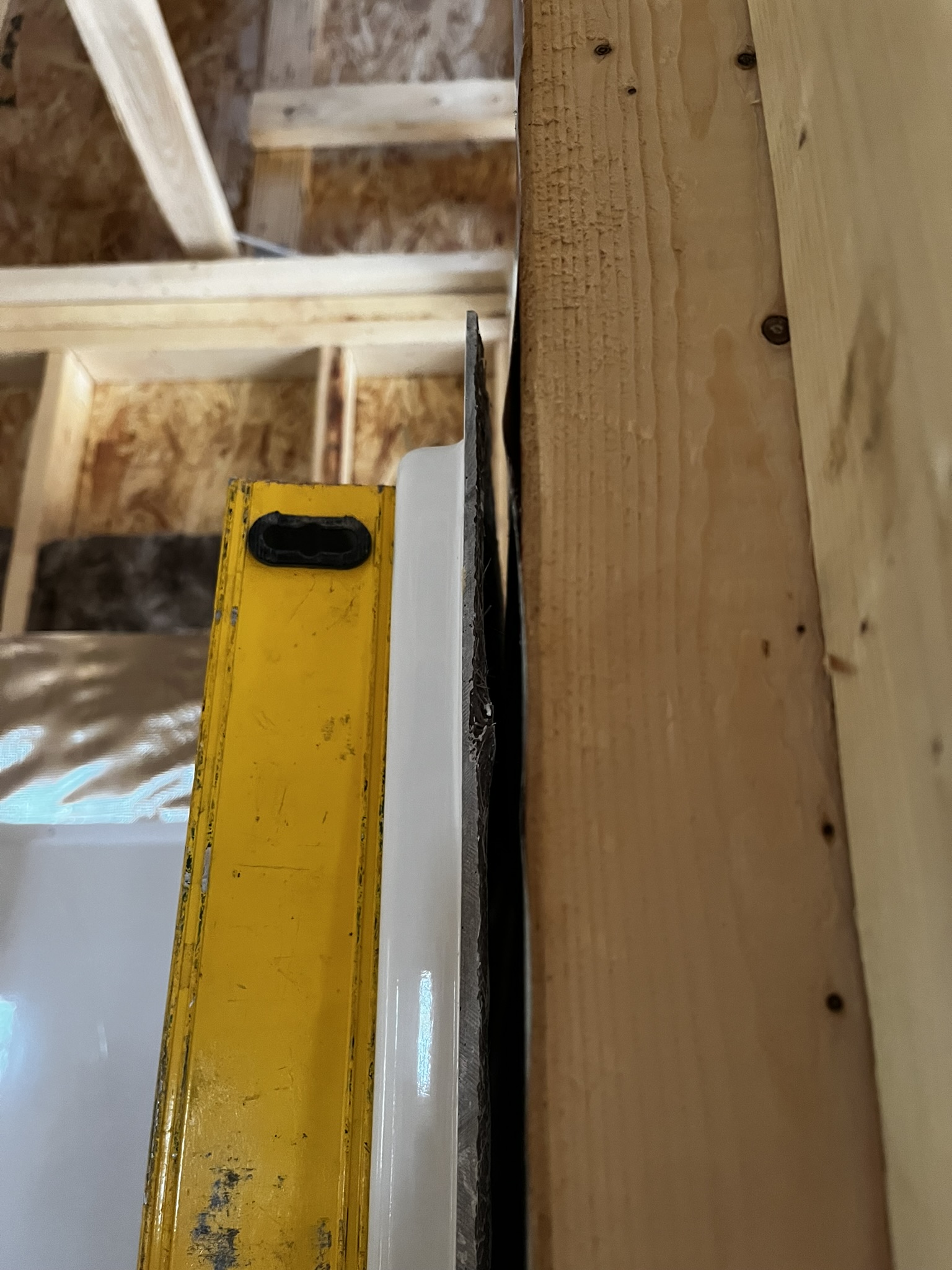
My plumber caught it while setting the shower and let me know that day. He determined that he could set the unit, leave the flange loose and let the framer straighten the wall.
Then he could fasten everything when he returned to test the house.
The important part wasn't just noticing the problem.
It was communicating before the problem disappeared behind the next stage of work.
I still should have caught it, but maybe I wouldn't have.
But every superintendent knows there is a version of the day where you don't.
That's why good trades don't just install around a problem and keep moving.
If this was worth the 5 minutes it took to read, forward it to somebody else!
See you next Friday.
Try not to get a bad Google review over something that was technically "within tolerance."
— David
Frequently Asked Questions
Is there a standard tolerance for how much variation is acceptable in construction?
No single tolerance applies across a whole house. Acceptable variation depends on the material, the application, the manufacturer, and whatever performance standard applies to that specific component. A 1/4-inch on a long foundation wall and a 1/4-inch on a wall meeting a countertop are not the same problem.
Why does meeting a written tolerance sometimes still look wrong?
Because context changes what's visible, not just what's measurable. The same variation can go unnoticed on an empty wall and become an obvious gap once something with a long straight reference line, like a countertop or cabinet, sits next to it.
What should a trade do when they find an out-of-plumb wall or similar issue mid-install?
Communicate it before it disappears behind the next stage of work, not after. In this case the plumber caught an out-of-plumb wall while setting a shower, left the flange loose, and let the framer correct it before fastening everything on a return trip, rather than installing around the problem and moving on.
Get the next issue in your inbox.
Jobsite intel, market data, and construction mishaps. Every Friday.