Issue #10 — August 14, 2026
Build for the Buyer, Not the Pinterest Board
What sells a house?
The lot itself?
The house plan?
A pot filler, tile showers, selling agent, buyer's agent, marketing?
In a market like today, it's probably some combination of all of it.
Gone are the days, at least for now, where you could put a real estate sign on a portajohn and it'd sell for $20k over asking price with multiple offers.
But we are not in the same market we were a few years ago.
Even back then, the principles of selling a good product still applied.
A lesson I learned that ties into last week's discussion is that not everyone is going to think the same as you.
What you think is nice and will help sell a house doesn't always translate to the market.
Jobsite Conditions
🚽 1 — Porta-John Complaints Fielded.
✅ 3 — Inspections Passed.
🌡️ 3 — Days the Heat Index Hit 100°. Productivity left the jobsite around 1PM and didn't come back.
🍟 1 — Fast Food Stops. Called it lunch. It was survival.
The Good News / Bad News
The Good News: The buyer loved the house.
The Bad News: Not for any of the reasons you thought he would.
In the Trenches
About four years ago, back when the market was still red hot, I was building on a lot that had some difficulties.
The land had a drastic slope to it running from right to left. There was somewhat of a backyard view, but a lot of it faced the neighboring cul-de-sac.
This slope was bad.
And I was still very green.
I'm going to get this out of the way now so I can shake off the embarrassment, but by now this should be obvious.
Experienced supers are going to catch things like, oh I don't know, an elevation change of ~10' from right to left and have it rough graded accordingly from the very start.
This was a lot to remember.
It's a moment in my career I'll tell my grandkids about right after the "I walked to school in 2' of snow" and "You don't know what hot is" stories.
I sometimes envy the supers that get those nice, buttery engineered pads.
Nice and low mono slabs that you can just rock 'n roll on.
But then I'm reminded that those dudes have 50 or so houses under construction at any given time, all while having to deal with HR and national corporate jargon.
So I'll take my bad lots when they come. They're great learning experiences anyways.
The main thing was that I should have seen this lot as a disaster from the get-go and planned accordingly.
Luckily, we were in a good market, and we were able to get the front yard looking really nice and unique from the other houses you typically see.
The only problem I had left was this tower of a front porch.
That was the lay of the land and not necessarily my fault.
But it was still my problem to deal with.
Planting trees wasn't going to solve it.
Try planting 4' bushes in front of a 12' wall and telling a buyer, "Don't worry, just give it 5 years and you'll have the prettiest hedge to cover up your foundation wall."
So I got creative.
I started thinking about the big porches you see on beachfront houses where they run horizontal slats across them.
It adds dimension and character.
I thought it was the coolest idea.
So did most everyone I ran the idea by.
So I went with it.
It's difficult to see the finished product with this picture, but everything blends in which is what I was going for.
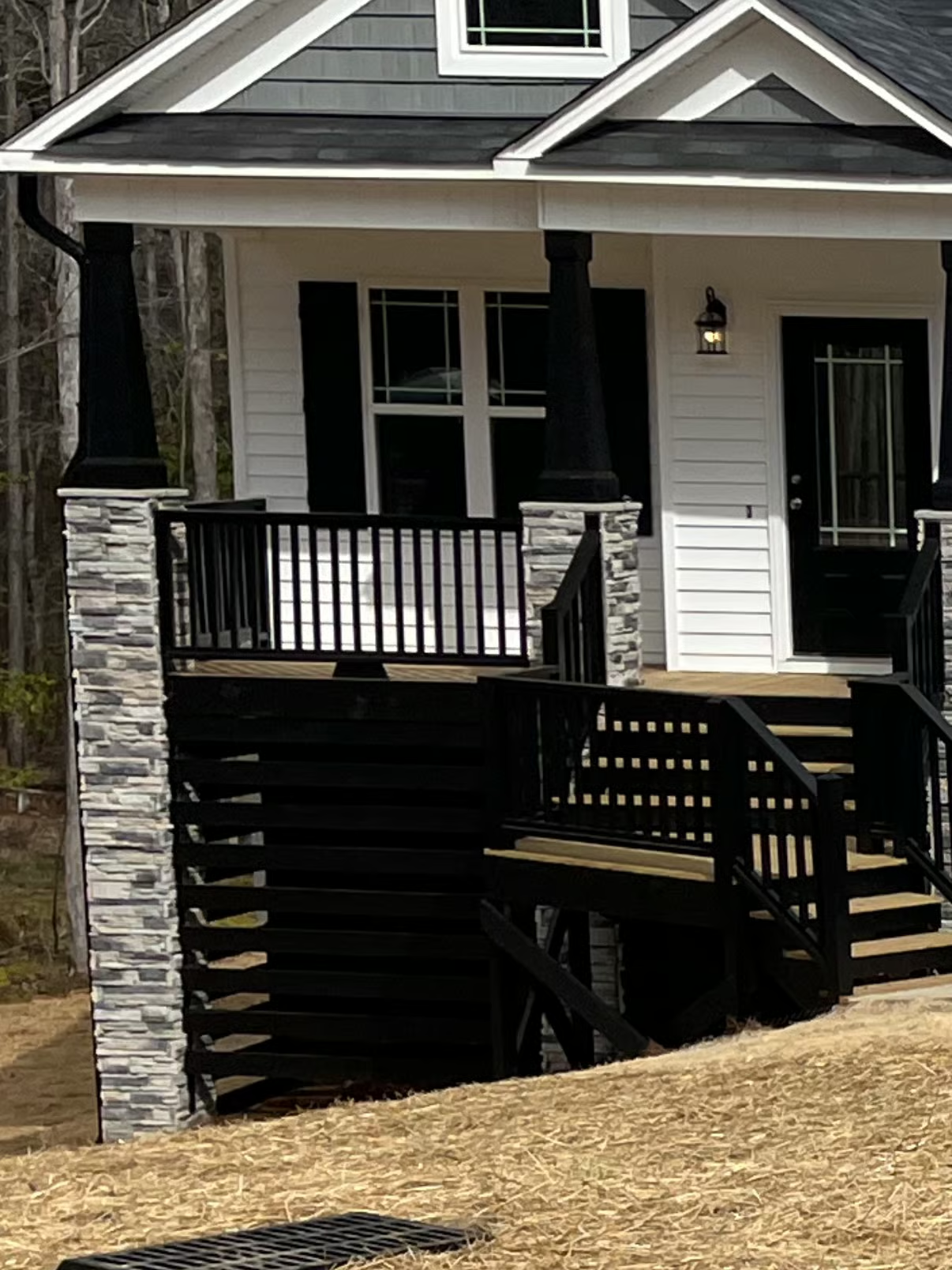
Painted the slats black. Painted the foundation wall black so it would all blend together.
I spent days pondering, planning, and finishing that porch.
The house sold during that time, which was awesome news because this house definitely took a lot more work and money to complete.
I'll never forget what the buyer said at the walkthrough when we discussed the front porch.
'I don't really like it that much, to be honest.'

I was without words.
I really thought in my head that was going to be a huge selling feature.
But that guy could have cared less.
He was a great buyer to work with during the walkthrough and closing.
But his comment made me realize something.
You can get on Pinterest, plan, install, and come up with all these grand ideas about what you think will sell a house.
They can help, sure. But they may not be the thing the buyer actually cares about.
Do you want to know what he told me was one of his favorite parts of the house?
That backyard that looked back on other neighbors' houses.
His back porch sat up high like the front porch.
He was a hunter, and there was a tree line on the left side of his backyard.
He wanted to hang out on that back deck and look at the deer and wild turkey that would come by every so often.
Didn't care about the trim.
Didn't care about the front porch slats.
Didn't care about the extra stone veneer.
Nope.
He liked the layout of the house and the lot it sat on.
The same lot I was so worried about to begin with.
I was trying to solve what I thought was the problem.
He thought it was the feature.
You can build what you think people want.
But they're the ones who get to decide what they actually want.
Code of the Week: Your block pier is not a skinny-legged table
2018 NC Residential Code — R404.1.5.4 (Piers)
The 2018 NC Residential Code says the unsupported height of a masonry pier cannot exceed 10 times its least dimension.
You can see I have a pier on the far left corner of that porch that's about 14.5' tall.
It's a solid 16" pier, so technically that math on unsupported height is 13' 4".
However, the deck framing provides lateral support at about 10', so the entire 14.5' isn't necessarily considered unsupported.
The important word here is unsupported.
Whether the framing actually provides the required lateral support is something I'd confirm with an engineer or your local building official.
If this was worth the 5 minutes it took to read, forward it to somebody else dealing with the same jobsite nonsense.
See you next Friday.
Build for the buyer, not the Pinterest board.
— David
Frequently Asked Questions
What does R404.1.5.4 require for masonry pier height in the 2018 NC Residential Code?
The unsupported height of a masonry pier cannot exceed 10 times its least dimension. Lateral support partway up a pier, such as deck framing, may reduce what counts as unsupported height, but whether a given connection actually qualifies as adequate lateral support is a judgment call. Confirm with an engineer or your local building official before relying on that interpretation.
Do homeowners actually value the design features builders spend the most time on?
Not always. Builders can invest significant time and cost into a feature they believe will be a strong selling point, only to find the buyer cares far more about something else entirely, like the lot layout or a view, that was already there from the start.
How do you know what home buyers actually care about?
Ask them directly, and don't assume a feature is valuable just because it photographs well or trends online. What sells a house is often more specific to that individual buyer than any universal design principle.
Get the next issue in your inbox.
Jobsite intel, market data, and construction mishaps. Every Friday.