Issue #9 — August 7, 2026
The Cost of Better
A couple of months ago I came across a guy from the Northwest US on social media who builds some incredible decks.
The dude's work is top-notch.
The kind of work where you zoom in on the pictures just to appreciate how clean everything is.
He was walking through one of his floor systems explaining why he chose the LVLs he installed.
Pointing at the joists wearing his POV camera, he comments:
'These things could span twice this distance if needed.'
That got me thinking.
At what point does "better" just become more expensive with little added value?
Current Market Conditions
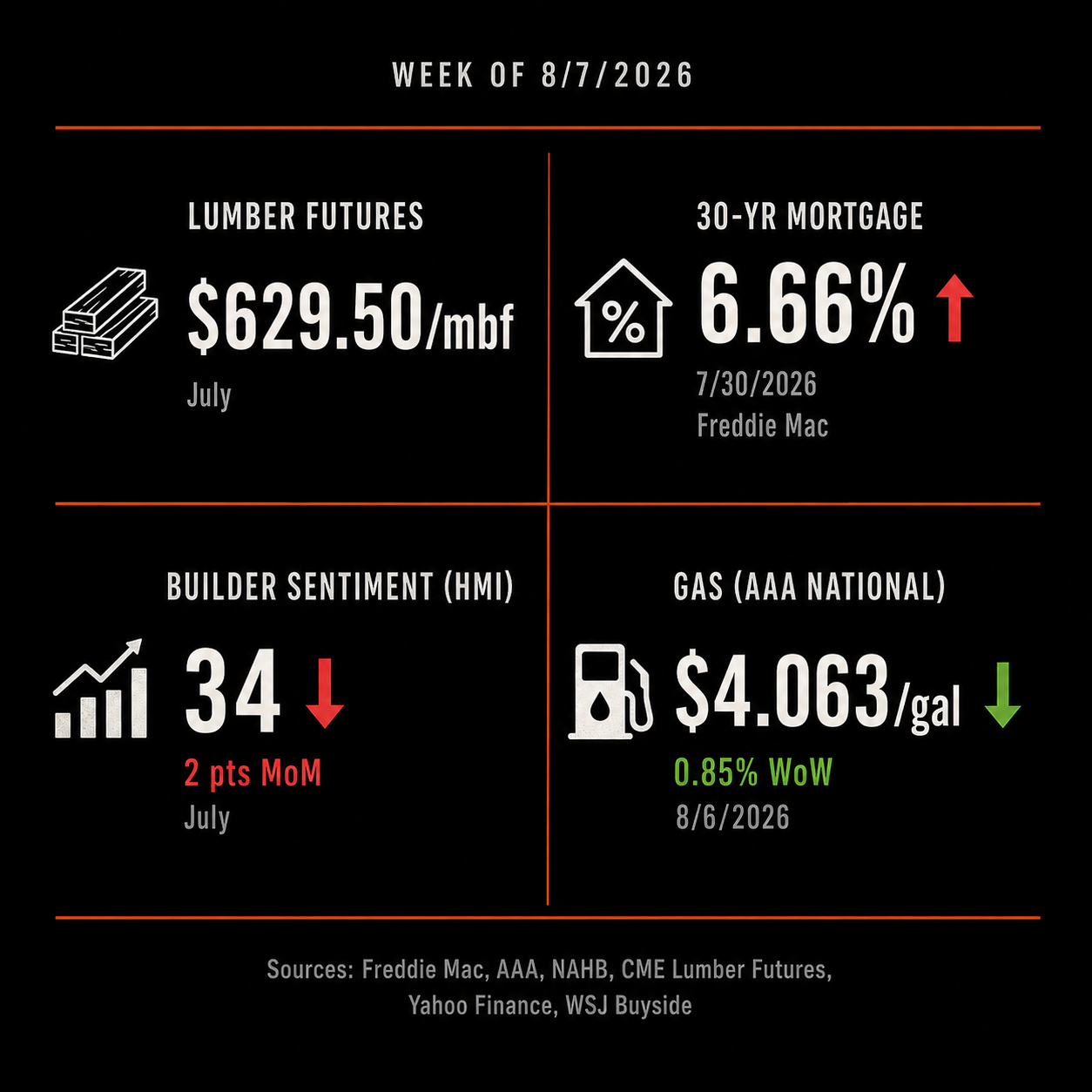
The Good News / Bad News
The Good News: Gas prices edged lower over the past week.
The Bad News: Those gas prices are about 7% higher from a month ago.
The Cost of "Better"
First off, this isn't me picking on the guy.
I'd let him build a deck at my house tomorrow.
His work is beautiful.
But something about that video stuck with me.
He wasn't just using those engineered joists because that particular span required them.
Another part of the deck did.
So instead of switching sizes, he kept everything the same.
Cleaner.
Simpler.
Nothing wrong with that.
But somebody paid for it.
And that's where my brain starts asking questions.
Did the customer actually receive more value?
Or just more material?
Those aren't always the same thing.
Or maybe the customer wanted the same size.
That's a possibility too, especially if saving money wasn't a factor in what they wanted out of the project.
I think about that a lot when building houses.
Engineers lean toward caution.
That's their job.
And it's necessary if you believe in Murphy's Law.
What can go wrong, will.
I'd much rather have a little extra than not enough.
Sometimes that leeway saves you.
Sometimes it is the difference between needing a simple letter of approval or tearing everything out and rebuilding the mistake.
But the builder still has a responsibility.
If a conventional header does exactly what an LVL does…
Why spend the extra money?
If a standard framing layout meets the requirements...
Why add more material just because it feels better?
Pick any example you'd like out of the hardhat.
Maybe there is a good reason.
Sometimes there is.
Maybe it makes installation easier.
Maybe it reduces mistakes.
Maybe it makes the finished product cleaner.
Those are real benefits.
But they still have a cost.
And somebody has to decide whether that cost is worth it.
And does that cost get pushed onto the client, or the builder?
You'll find that can be somewhat of a rabbit hole.
You already know a big part of the job is trying to catch the expensive mistakes and unnecessary costs before they become expensive mistakes and unnecessary costs.
If you're a super, a PM, or a mix of both, your client is more than likely your boss and the company.
I'm not sitting across the table from a homeowner designing their house and deciding where they should spend their money.
Most of the time, I'm trying to make sure we build the house correctly without spending money where we don't need to.
Somebody has to keep an eye on the money.
If you're running the job, you already know who that somebody is.
I've been on the other side of it too.
I remember when my wife and I were building our house.
That was completely new to me.
I had a house before that I completely renovated.
But this was my first ground-up personal build.
I would get opinions every now and then from my boss, who was more than happy to help in the process.
I wasn't building a truly custom home.
It was semi-custom, you could call it.
He said something to me that stuck after the budget started filling and what felt like a life of its own.
Whenever I would need advice on add-ons or changes to what I was doing, he'd say:
'I'll spend your money in no time.'
His point referred to the old saying, "watch your pennies."
And he was right.
We stayed within budget, but from the very beginning, I tacked on an extra ~20% for variables.
But it was surprising to me how quickly things add up.
Extra outlets.
Additional paint colors.
Added exterior and interior trim.
Closing off the crawlspace and adding a dehumidifier.
Black aluminum color upgrade for the screen porch.
Increasing the radius of my 3rd car garage door tracks.
That one was kind of stupid to be honest.
Little things slowly added weight to every later-on decision you'll make throughout the process.
And there will be many other things that will be out of your control.
I was lucky enough to build right in the middle of COVID.
My lumber package went up nearly 20% in the span of 30 days before I had the lot ready to deliver the material.
And that was already after a couple previous price increases within the industry.
Many other things went up during that time as I'm sure you remember.
Including everyone's blood pressure.
Relating this all back to the talented carpenter building the deck out west, you can see how things add up when scaling to the point of an entire house.
One LVL probably isn't going to make or break a project.
Neither is an extra outlet.
Or another paint color.
Or a nicer screen porch.
Maybe the garage door tracks.
MAYBE.
But construction is full of decisions like that.
And eventually, they all end up on the same invoice.
The best-run building companies don't spend the least money.
They don't spend the most money either.
They spend money where it matters.
That's part of the job too.
Because nobody is going to catch every unnecessary cost for the job.
If you're running the job, you already know how quickly reasonable decisions can add up.
And sometimes the best decision isn't the one that costs more.
It's the one that works.
If this was worth the 5 minutes it took to read, forward it to somebody else!
See you next Friday.
— David
Frequently Asked Questions
Who is responsible for catching unnecessary material costs on a residential build?
Usually the superintendent or PM, not the homeowner. On most residential jobs, the person running the project is managing cost on behalf of the builder or company, not sitting across the table from the client making design-spend decisions directly.
Is it ever worth using oversized or upgraded materials beyond code minimum?
Sometimes. Extra capacity can reduce installation mistakes, add a safety margin, or make the finished product cleaner. Those are real benefits. But they still carry a real cost, and someone has to decide whether that cost is worth it for that specific job.
Get the next issue in your inbox.
Jobsite intel, market data, and construction mishaps. Every Friday.